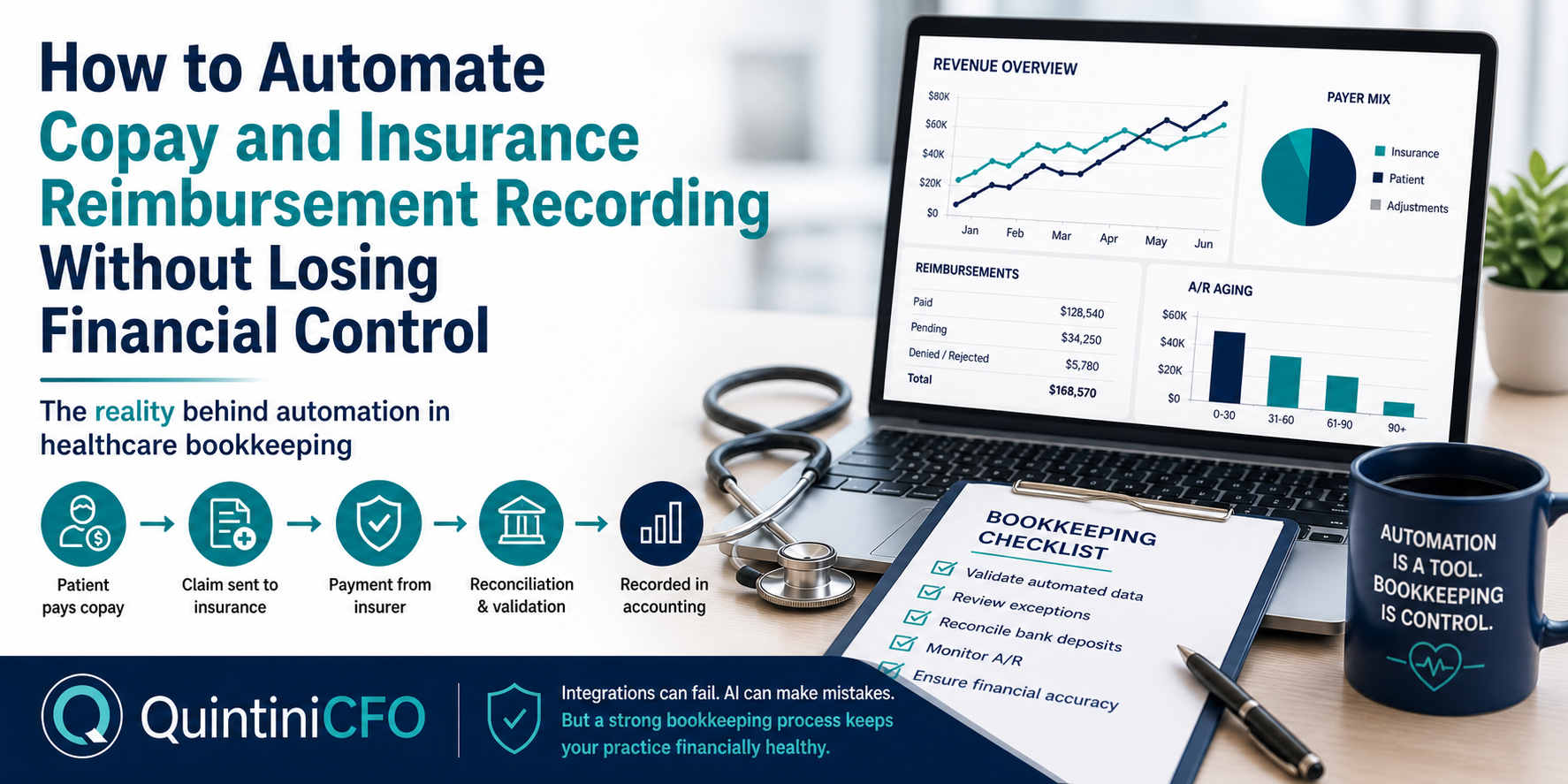
The Reality Behind Automation in Healthcare Bookkeeping
Over the past few years, automation has been sold as the ultimate solution to operational problems in healthcare. Promises like “close your books on autopilot” or “forget manual accounting” sound appealing especially for clinics and medical practices overwhelmed with administrative work.
But the reality is different.
Automations fail.
Integrations break.
And AI makes mistakes.
When it comes to recording copays and insurance reimbursements, this isn’t a minor issue. it’s a direct risk to cash flow and financial decision-making.
So the real question isn’t whether you should automate.
The right question is:
👉 How do you automate without losing control?
The Myth of Perfect Automation
In theory, the process should be simple:
- The patient pays a copay
- A claim is submitted to the insurance company
- The insurer pays
- Everything is recorded automatically
In reality, that flow rarely works without friction.
What actually happens:
- Copays are recorded with missing details
- Claims don’t match incoming payments
- Reimbursements are partial or adjusted
- Integrations stop syncing data
- Systems duplicate or lose transactions
And most importantly:
👉 Many of these errors are not immediately visible.
The Problem Isn’t Technology. It’s Blind Dependence
Automation itself isn’t the problem.
Blind reliance on automation is.
When a clinic assumes “the system handles everything,” it loses visibility.
And when it loses visibility, it loses control.
This leads to:
- Unreliable financial statements
- Decisions based on incomplete data
- Unexpected cash flow issues
- Time wasted fixing accumulated errors
Automation in Healthcare: A Tool, Not a Replacement
Well-implemented automation does have real value:
- Reduces repetitive tasks
- Speeds up transaction recording
- Minimizes basic human errors
But it has clear limits:
- It doesn’t interpret complex exceptions
- It doesn’t validate the full financial flow
- It doesn’t reliably detect anomalies on its own
In other words:
👉 Automation processes data
👉 Bookkeeping ensures that data makes sense.
The Real Challenge: Copays and Reimbursements
This is one of the most complex flows in healthcare accounting.
A single patient visit can generate:
- An immediate copay
- A claim submission
- A partial payment weeks later
- Contractual adjustments
- Outstanding balances
Trying to fully automate this without oversight is a recipe for silent errors.
Where Automation Actually Breaks
To design a better system, you have to accept where things fail:
1. Unstable Integrations
Systems don’t always sync properly.
A failure can leave days or weeks of data missing.
2. Imperfect Matching
Insurance payments don’t always match claims exactly.
Systems may:
- Fail to match
- Match incorrectly
- Ignore differences
3. Incomplete Data
If front desk staff or clinical systems capture poor data, automation simply scales the problem.
4. External Changes
Insurers constantly change rules, formats, and payment timing.
Automation doesn’t always adapt instantly.
5. AI Has a Margin of Error
AI can classify and suggest—but it does not guarantee accuracy.
There is always a margin of error.
So… Is Automation Worth It?
Yes—but with one condition:
👉 Automate for efficiency, not at the expense of control.
The goal is not to eliminate human work.
It’s to focus it where it matters most.
The Role of Bookkeeping in an Automated System
This is the point most people miss:
👉 The more you automate, the more important bookkeeping becomes.
Because someone still has to:
- Validate data accuracy
- Detect inconsistencies
- Correct errors
- Interpret financial information
The bookkeeper is no longer just recording transactions.
They become:
👉 A financial control system
How to Automate Without Losing Control (In Practice)
1. Design the Flow Before Automating
Don’t automate messy processes.
Define:
- How copays are recorded
- How claims are tracked
- How payments are received
2. Standardize Your Accounting Structure
Clearly separate:
- Patient revenue
- Insurance revenue
- Adjustments
- Accounts receivable
This makes errors easier to detect.
3. Automate the Repetitive, Not the Critical
Automate:
- Copay recording
- Payment imports
- Basic reconciliations
Keep human control over:
- Adjustments
- Discrepancies
- Final validations
4. Build Rules, Not Just Integrations
Integrations connect systems.
Rules define behavior.Example:
- If there’s a variance → classify as adjustment
- If no match → flag for review
5. Create Control Checkpoints
Without this, failures go unnoticed.
Include:
- Weekly revenue reviews
- Bank deposit validation
- Accounts receivable analysis
6. Accept That Manual Work Will Always Exist
This is the honest truth:
👉 Manual intervention will always be necessary.
And that’s not a failure.
It’s part of maintaining control.
The Real Model: Hybrid Systems
What actually works in healthcare is a hybrid model:
Automation + Human Oversight
- Automation handles volume
- Bookkeeping ensures accuracy
Neither replaces the other.
Simplified Real-World Scenario
A high-volume clinic:
Before:
- Heavy manual entry
- Frequent errors
- Low visibility
After automation without control:
- Less manual work
- But hidden errors
- Misleading reports
After implementing a hybrid system:
- 70–80% automated
- Strategic human oversight
- Reliable financial data
The Competitive Advantage (For Bookkeeping Services)
This is where you differentiate yourself.
Don’t sell automation as magic.
Sell:
👉 Control over automated systems
That includes:
- Smart implementation
- Ongoing oversight
- Financial interpretation
Because anyone can connect software.
Very few can ensure it actually works correctly.